For the most part, global discussion around Artificial Intelligence often defaults to debates about Silicon Valley, European, and Chinese regulatory models. For African nations, however, AI is not just a tool for enhancing the efficiency of AI governance — it is a critical lever for sustainable development, economic transformation, and social equity. This shift in perspective calls for the design and governance of models to be deliberately anchored in local political, historical, and economic contexts.
A recent study by Thompson Gyedu Kwarkye (2025), comparing the AI policy landscapes of Rwanda and Ghana, provides a robust validation of what we might call an ‘AI for Sustainable Development’ (AIForD) paradigm. This mandates prioritization of national values over generic global replication.
Key takeaway: Context Is King
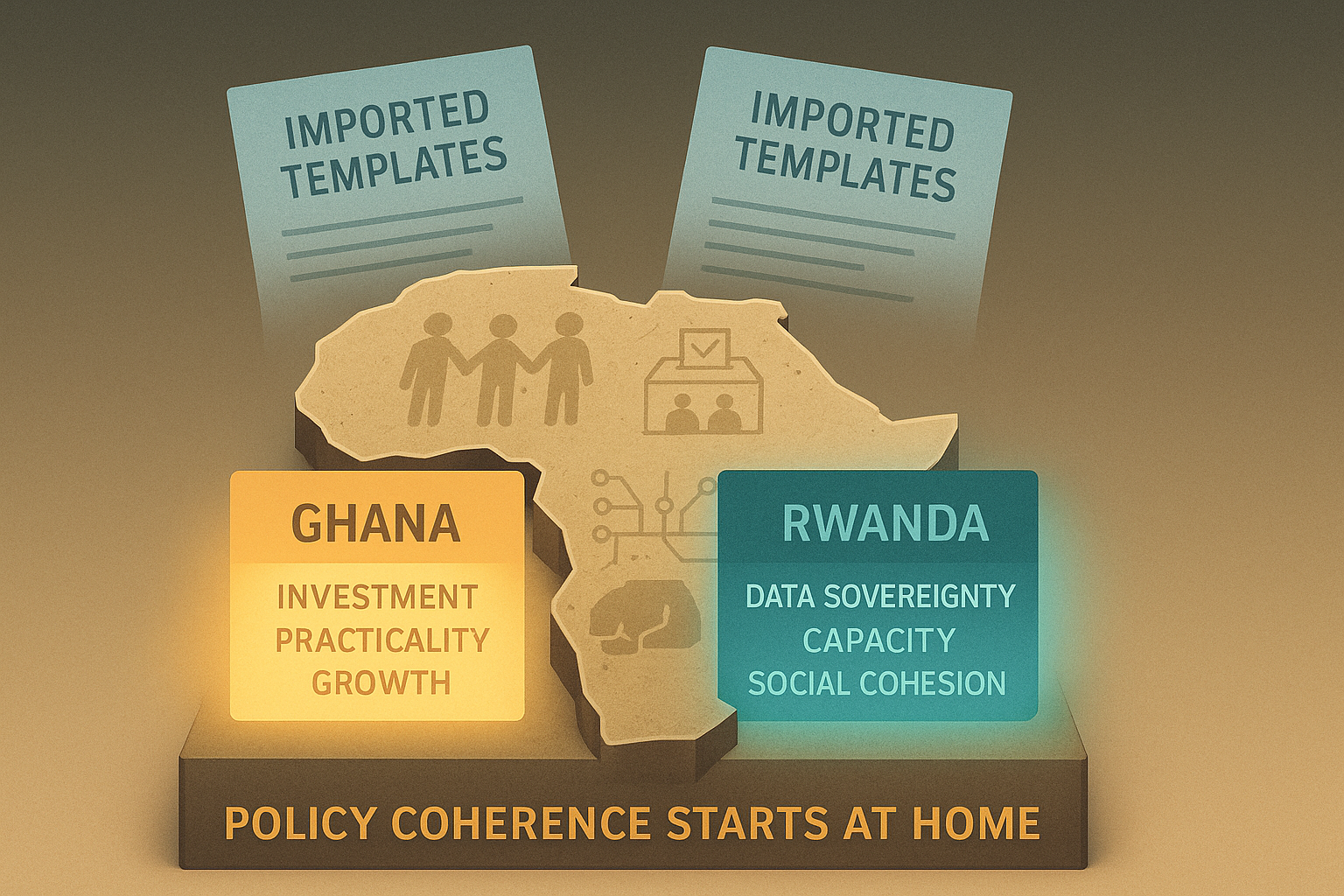
Rwanda and Ghana’s contrasting policy approaches demonstrate that policy coherence should derive from the country’s unique ideals, not external models. If you want to adopt these models — for adoption’s sake — we can fail! The real opportunity for Africa lies in using AI to actually “leapfrog developmental hurdles.” This means we need to prioritise local capacity and data sovereignty over mere efficiency. If we want to develop a national AI strategy, the first thing we must do is define our political and historical context as a base for our policy framework. That way, we avoid the absurdity of leveraging AI to move with maximum efficiency in the wrong direction.
Deconstructing the AI Policy Tension in Sub-Saharan Africa
Thompson Kwarkye’s study revealed a fundamental tension in governance for Africa’s AIs — countries may share a commitment to establishing AI standards that maximise benefits and minimise risks, but the reasons behind their engagement often vary greatly.
Rwanda and Ghana reproduced the same initiatives, giving birth to oversight offices. Yet they do differ significantly in AI vision, usability, and data sovereignty. This is where the context becomes everything.
The AI policy vision in Rwanda is motivated by the history. The aim is to focus on the building of local capacity and data sovereignty. It highlights the importance of social cohesion and trust in maintaining social stability.
Ghana’s policy emphasizes leveraging investments in generic AI to address development challenges. It regards AI as a tool for technological competition and economic development.
So, if you are a policymaker interested in AIForD, then this comparison validates a context-sensitive heuristic of sorts. That is, AI strategies should be understood as tools that can help leapfrog development barriers. Specifically, these barriers refer to gaps that exist because of resource deficits or the fragility of the state. AI can help process vast amounts of data and help with the decision-making process. However, this must be done in a manner that aligns with societal norms and sustainability principles.
Source and Evidence
Article title: “We know what we are doing”: the politics and trends in artificial intelligence policies in Africa. Link: https://www.tandfonline.com/doi/full/10.1080/00083968.2025.245661
Abstract
In the last decade, several actors have encouraged African countries to establish standards, policies, and strategies that maximize the benefits of artificial intelligence (AI) and reduce risks. African countries appear to be adopting this regulatory path, yet their motivations and political contexts for actively engaging in AI policies vary, as do the values, principles, and ethical issues woven into these policies. With qualitative evidence from Rwanda and Ghana, the paper explores the complex interplay of politics, power, and local ecosystems in policy development on the continent. It unpacks the strategies of mobilizing knowledge through stakeholder engagements, agenda setting, and valid public and political engagements that lead to the final AI policy. A comparative analysis of the policies in the two countries finds that while reproducing identical initiatives, there are differences in AI vision, practicality, and data sovereignty based on political, economic, and historical contexts.
And So, What’s Our Next Move in the AIForD Journey?
The conversation around AI in Africa cannot afford to be passive. It must be driven by policies developed through context-driven approaches, ensuring that they reflect local needs and capabilities. By consistently analyzing new research through the lens of national strategy and social equity, we can help African nations not just cope with the AI era but also actively shape its trajectory for sustainable growth.