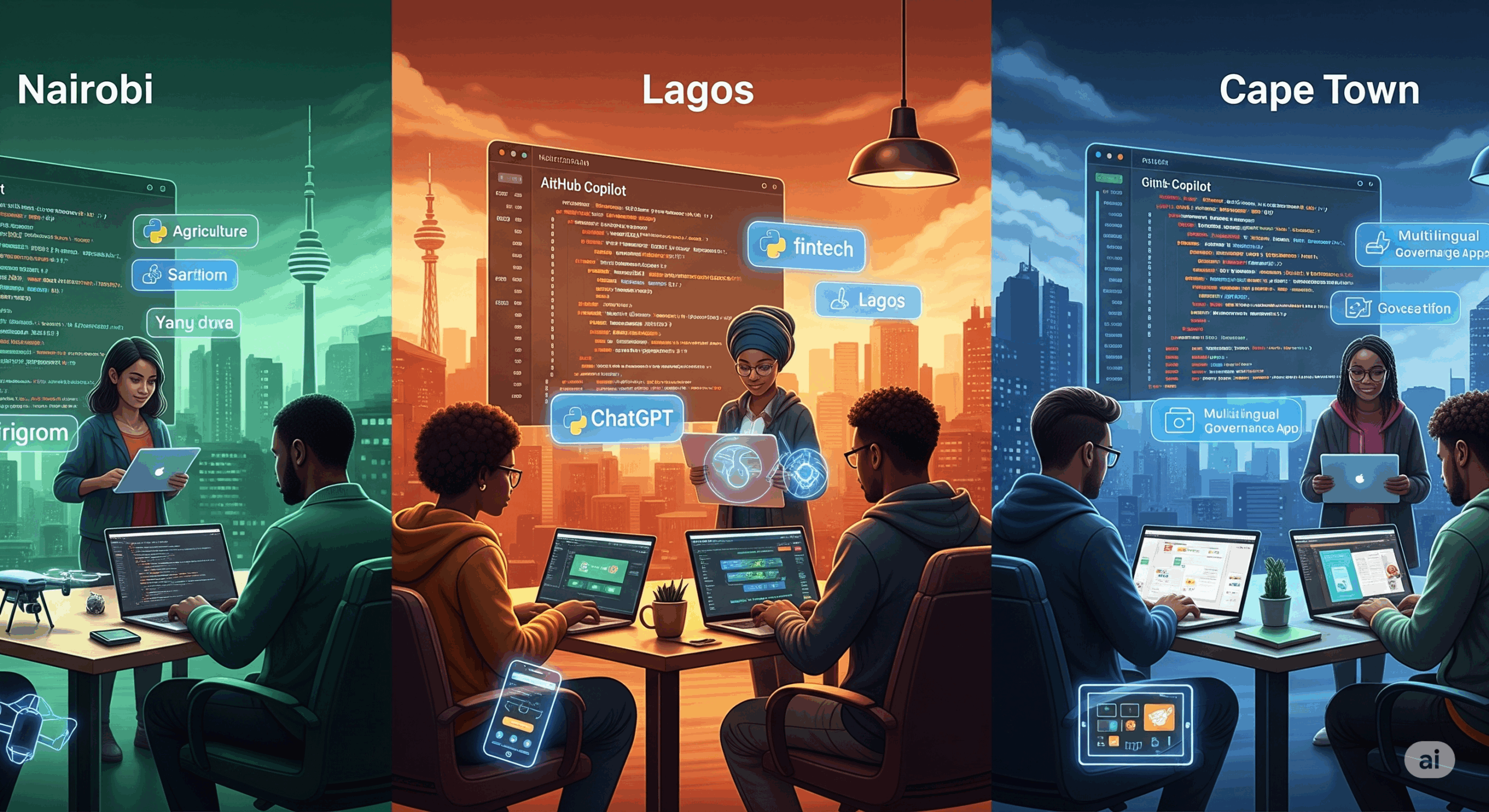
Across the African continent, a quiet but meaningful transformation is underway: small and medium enterprises (SMEs) are beginning to adopt generative AI programming tools to build software faster, more affordably, and with fewer technical bottlenecks. These tools (ranging from GitHub Copilot and ChatGPT to more localized coding assistants) are doing more than simply helping developers write cleaner code. They’re enabling African SMEs to make meaningful contributions to the Sustainable Development Goals (SDGs) by accelerating digital solutions in agriculture, governance, education, and manufacturing. One might say these developments send a strong message that the continent intends to be an active player at the cutting edge of the 4th Industrial Revolution.
This blog post offers initial findings from an ongoing continent-wide mapping of AI-assisted programming tool usage by African SMEs from 2023 to 2025. In addition to spotlighting early adopters, this project also seeks to identify how AI tools are applied at the micro-level for pair-programming, code generation, or debugging. We are also exploring what these developments could mean at a higher level applications that can be leveraged to address the complex issues at the nexus of, say, energy-development questions of the kind organizations like AISESA are actively pursuing.
Early Adopters: Who’s Using What Where?
| SME | Country | Sector | AI Tool(s) | Use Case |
|---|---|---|---|---|
| One Acre Fund | Kenya + 10 ops | Agriculture | GitHub Copilot | Used for pair-programming and debugging; 30% of code AI-assisted by 2024 |
| JUMO | South Africa | FinTech/Governance | GitHub Copilot | Improves coding speed and debugging efficiency by up to 80% |
| CDIAL.AI | Nigeria | Governance/Language | Proprietary GenAI | Automates code for chatbot workflows, internal API debugging |
| Bolthale AI | South Africa | Governance/NLP | ChatGPT-backed tools | Generates NLP pipeline code for multilingual inclusion apps |
| Innovation Village–supported startups | Rwanda & others | EdTech/Health/Agritech | ChatGPT, Copilot | Used for front-end prototyping and debugging, though specific SMEs (yet to be identified) |
Timeline of Adoption
- 2023: GitHub Copilot emerged among early adopters in agriculture and fintech, aiding backend services and API development.
- 2024: ChatGPT and Codex-style models gained traction for prototyping and boilerplate code in Kenya, Nigeria, Zambia, and South Africa.
- 2025: Copilot Agent Mode became available, supporting semi-autonomous coding and debugging, especially in governance and agriculture.
Cross-Sector Use of AI Tools
Education
- Tools like Kwame for Science and SuaCode Africa use AI for grading and instruction. SuaCode and Kwame have collaborated to add a featurs that is helping users “…[l]earn to code on your phone with friends and Kwame…” an AI Teaching Assistant.
Agriculture
- One Acre Fund is using Copilot for backend workflows and debugging.
- Though not yet publicly documented, there are signs of informal ChatGPT use in Kenya and Zambia, but not publicly documented.
Manufacturing
- AI adoption is minimal. Current applications focus on logistics and inventory, not core software development. We will dig deeper into this critical area subsequently.
Governance / Civic Tech
- Indigenous.ai Automates translation workflows using proprietary AI.
- Bolthale AI uses ChatGPT pipelines to generate NLP code for inclusive communication platforms.
What’s Holding Back Broader Adoption?
- Visibility Gap: Most SMEs do not publicly share which coding tools they use, limiting mapping efforts.
- Sector Skew: FinTech and agriculture dominate; manufacturing and education lag behind.
- Tool Monoculture: GitHub Copilot is widely reported, but alternatives like Gemini or Tabnine are rarely mentioned.
Alignment with the SDGs in Africa
- Goal 8: Decent Work and Economic Growth
- Goal 9: Industry, Innovation and Infrastructure
- Goal 4: Quality Education
What’s Next?
- Incentivize more SMEs to openly share their AI coding practices, for example student internships.
- Create sector-specific training on responsible AI development.
- Foster partnerships between African developers and global AI platforms.
- Establish robust monitoring and evaluation systems to track progress.
Initial Thoughts
Generative AI coding tools could be Africa’s shortcut to a more inclusive, innovation-driven digital future. The adoption and scaling of these tools can be accelerated if governments deploy innovative policies and multilevel strategies for increased access, transparency,…in a word, Good Governance!
This mapping is just the beginning.
Anyway, dear reader, we have a gentle request of you: Please share any insights, case studies of SMEs using AI-assisted tools in Africa.
Drop us a message—we’re actively compiling more data to track how Africa codes its way to the SDGs.