Introduction: A New Chapter in Africa’s Tech Story
Across Africa, a quiet revolution is brewing. Vibe coding—the ability to build apps by expressing ideas naturally, without deep programming knowledge—could transform millions from passive technology consumers into active creators. The promise is compelling: faster innovation, accessible app-building, and new opportunities for digital entrepreneurship.
But there’s a challenge. If implemented without care, vibe coding could open doors to cybersecurity risks, widen technical knowledge gaps, and weaken Africa’s digital sovereignty. To truly serve Africa’s future, vibe coding needs more than enthusiasm—it needs a hybrid approach that blends ease of access with solid technical foundations.
The Double-Edged Sword of Vibe Coding
Like any powerful tool, vibe coding can either unlock progress or create unintended problems. Here’s why unstructured adoption could backfire:
- Security risks: AI-generated apps without proper checks can be vulnerable to cyberattacks, especially in sensitive sectors like finance, healthcare, and public services.
- Knowledge gaps: Relying solely on drag-and-drop tools risks creating “citizen coders” who can assemble apps but lack the deeper skills to maintain or scale them.
- Digital dependence: Heavy reliance on foreign platforms, without localized adaptations, could limit Africa’s control over its digital future.
The solution isn’t to slow down vibe coding but to build a bridge between accessibility and technical depth—a hybrid model that grows skills while empowering innovation.
What a Hybrid Approach Looks Like
A well-planned hybrid strategy would:
- Put education first: Integrate vibe coding into school and university curricula, giving students both intuitive tools and foundational programming knowledge.
- Embed security: Create review protocols to test and safeguard vibe-coded applications, particularly in mission-critical sectors.
- Offer certification pathways: Recognize developers who master both AI-assisted coding and traditional programming skills.
- Develop local platforms: Build homegrown African solutions with built-in education and security features, reducing dependency on foreign tools.
This model balances speed and safety, democratizing coding while ensuring that innovation is sustainable and resilient.
Hands-On Learning: Building and Understanding Your App with Lovable
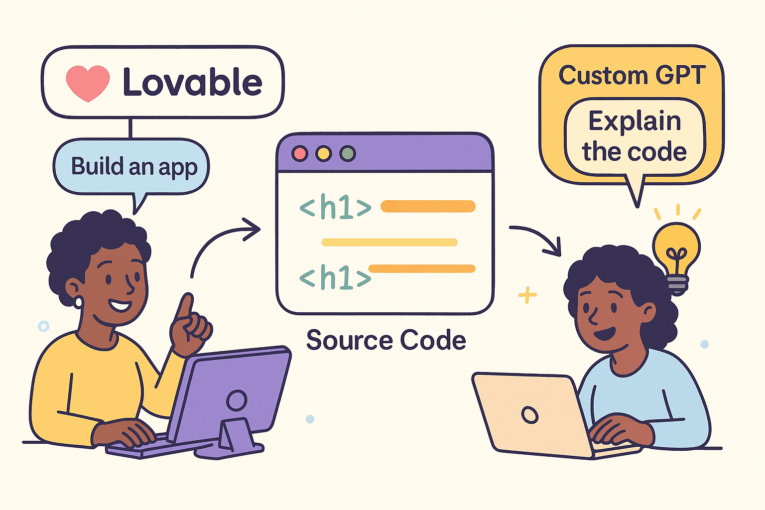
One way to experience this hybrid approach today is by combining AI-assisted app building with guided learning. Tools like Lovable let you build apps in minutes, but the real power comes when you look under the hood and learn how your app actually works.
Here’s a beginner-friendly workflow:
Why This Matters
Imagine buying a car, driving it everywhere, but never knowing what’s under the hood. You can get from point A to point B, but you can’t repair or improve it later. Accessing your app’s source code is like lifting the hood—it helps you understand how technology “thinks,” making you more than just a user.
What You’ll Need
- A Lovable account (free or paid)
- An app idea (e.g., “Build a communal savings platform where users contribute and track a shared fund”)
- A GPT assistant (like ChatGPT) to help explain code
- A laptop or tablet with a web browser
Build Your First App
- Log in to Lovable and click New App.
- Type your app idea and click Generate App.
- After a few moments, hit Preview App to see it in action.
In minutes, you have a working app—but let’s go deeper.
Explore the Source Code
- Open the Code or Files panel in Lovable.
- Click on files like index.html, style.css, or App.js to view what powers your app.
- Skim through the logic, database connections, and design files. This is the “engine room” of your creation.
Use GPT to Learn Line by Line
- Open GPT and enter the following prompt:
You are a master explainer with 25+ years of experience using the Feynman Technique to make complex topics radically simple and unforgettable. You break down concepts into their smallest parts, strip away jargon, and rebuild understanding from the ground up. You speak plainly, using vivid analogies, metaphors, and real-world examples so that anyone—even a tired adult or a curious 10-year-old—can fully grasp the topic and teach it to someone else. As my coding tutor, you will explain any code I paste in plain English, step by step, with simple analogies. Avoid jargon. - Copy a few lines of code (3–5 at a time) and paste them in GPT.
- Read ChatGPT’s explanation(s). Request clarification if necessary. Watch as complex code becomes simple, like:

In explaining this code, GPT might say: “Think of members as a guest list for a party. This function adds a new guest’s name to the list.”
Experiment and Build Confidence
- Try changing button text or colors.
- Hit Run to test your tweaks.
- If something breaks, undo or regenerate the app.
Every small experiment builds understanding—and confidence.
Beginner-Friendly Practice Prompts
Try these in Lovable for more learning opportunities:
- “Create a personal budget tracker app.”
- “Build a local food delivery app for street vendors.”
- “Design a weather alert app for West African farmers.”
Each prompt gives you real code to explore, edit, and understand.
Frequently Asked Questions
Q1: Can I mess up my app by opening the code?
No. Viewing is safe, and you can always revert or regenerate your app.
Q2: Do I need coding knowledge first?
Not at all. This workflow is designed for absolute beginners.
Q3: Can GPT explain all types of code?
Yes. Complex code may need follow-up questions, but you’ll get clear explanations.
Q4: Can I download my app’s code?
Yes. Look for the “Download Project” option in Lovable to save it as a ZIP file.
Final Thoughts: A Future Built, Not Bought
Vibe coding is a game-changer, but Africa’s digital future depends on smart adoption. By pairing AI-assisted coding tools with real learning pathways, we move beyond just building apps—we build skills, sovereignty, and long-term innovation.Every app you create, every line of code you understand, makes you a true tech creator, not just a tool user. That’s the kind of transformation Africa needs—and it starts with hybrid approaches that empower today and prepare for tomorrow.