Africa doesn’t suffer from a shortage of ideas. It suffers from the friction of getting good ideas to traverse difficult terrain, across mental paradigms, ministries, physical borders, and budgets, to implementation and scale. The Smart Africa Initiative seems well-positioned to fix this decades-old problem. (Sorry, i meant to write, ‘centuries’). SAS has secured a continental mandate, established a convening leadership, and boasts a deep bench of government and industry partners. The recently created AISESA is also well-positioned to help minimize the high fragmentation costs hampering transitions to the MDGs. The next move is now relatively simple: standardize how choices are framed, evidence is verified, and results are packaged so that credible pilots become programs that “catch on” and stick.
The primary task
Building an interoperable, evidence-led way of working that any Smart Africa project can snap into, and I’m not thinking about silver bullets here, but consistent documents, decisions, and deployments. If Africa wants speed, it must reduce variance in interpreting what needs to be done to accelerate transitions from pilots to programs. To earn stakeholder trust, evidence must be legible. To scale any pilot, each package should be boring, albeit in a good way.
Four moves that can reliably cut coordination costs
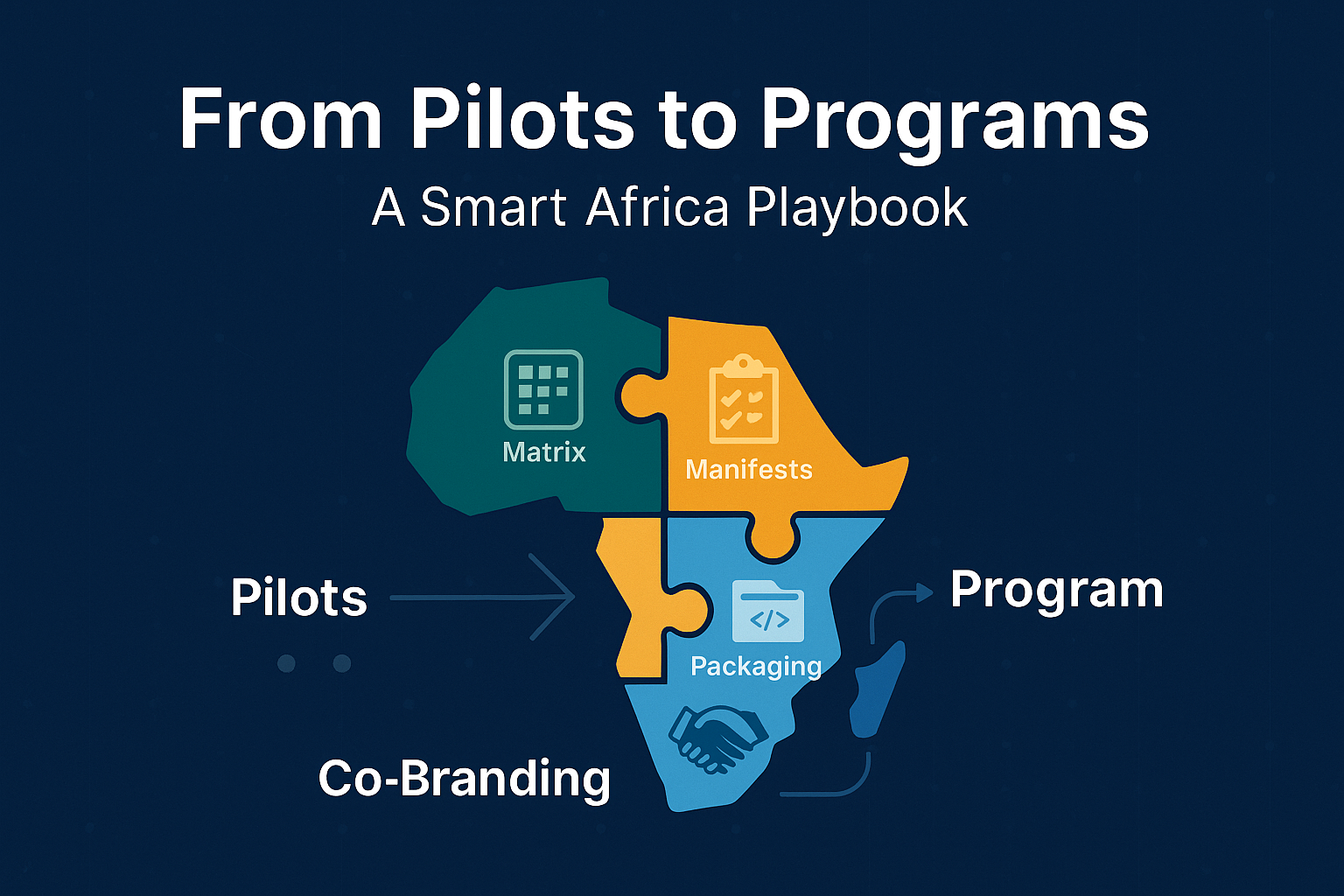
1) Matrix Generator: Building streams of comparable decision packs
This means using one co-branded templates for sector/country/use-case briefs: A simple two-page summary with page-numbered annexes for data, KPIs, and risks should do. This makes it relatively easy for decision makers to compare options, instead of wrestling with formats they can’t parse. An immediate benefit is that Proposal Team Leaders can focus on substance and not (as has too often been the case) competing on presentation slide designs and coffee cups at tea breaks!
2) Smart Manifests: A signed “what’s in the box”
Machine-readable inventories of all artifacts for each deployment (borrowing a concept from software design to the development policy and planning realm). These would datasets, methods/SOPs, equipment lists, test logs, monitoring plan, licenses, and named contacts. For regulators and DFIs, diligence becomes a checklist, not detective work. For procurements, contractors deliver verifiable things, not vibes (It’s generally easier to govern listed things, after all)!.
3) Consistent packaging: Guaranteeing the same outputs for the same inputs.
This ensures that filenames and folders for, say, Abuja, Kigali, and Accra regenerate the same PDF, same report, same configs from the same inputs. Everytime. That translates into reliable Go/No-Go gates, clean re-issues, and easier audits, especially important for reporting flows in projects like Smart Africa’s projects – Smart Devices and the Scholarship Fund.
4) Co-branding that points to the governance.
This calls for putting roles, SLAs, and data-sharing rules upfront, rather than forcing reviewers to spend scarce person-hours digging through thick annexes. For projects like One Africa Network today and E-Governance and the Broadband Database tomorrow, clear definitions of “who does what, who pays what, who maintains what” can save months of politics before the technical debate even starts.
(Rule of thumb: exciting pilots are fun to announce; “boring” packaging is what actually scales. Boring is fundable.)
Accelerating pilots-to-programs: Elements of a ‘Playbook’
- Inputs: shared data schemas, document templates, partner rosters, legal boilerplate.
- Activities: generate Matrix briefs → attach Smart Manifests → issue via consistent packaging → publish co-branded artifacts.
- Outputs: comparable briefs, signed manifests, reproducible PDFs, MoUs/SLAs.
- Outcomes: faster coalitions, shorter diligence, cleaner audits, reliable replication.
- Impact: more SDG-relevant solutions moving from pilot to program—and staying there.
Avoiding Hype: A constructive response to Brookings’ Critique of AI initiatives in Africa
Brookings warns about technosolutionism in the diverse community of AI-for-Africa advocates, theorists, and practitioners. They rightfully point out that too many solutions tend to chase headlines instead of solving public problems. For the most part, this critique is valid. However, the answer is not to downplay AI or digital; it’s to govern them better so that the value created by addressing specific pain points is visible, and promises are testable. Smart Africa and its partners reduce hype by publicly pushing technooptimists to satisfy at least three standards when making pronouncements:
- A one-page problem charter that captures the baseline, public outcome, and non-negotiables like safety, data residency, IP, and the like.
- A Smart Manifest for every pilot (what’s included, what was tested, who is accountable).
- Value-added at a glance: summaries per country for DFI/government-funded deployments (wage bill, local procurement, export sales). This way, programs from rhetoric to verifiable public value—and it’s the opposite of technosolutionism.
Applying the Playbook to Existing Portfolios and Upcoming Projects
The discussion up to this point might seem theoretical. Far from that, think of it as muscle memory waiting to be organized. Consider Smart Africa’s upcoming projects like E-Governance, Broadband Database, Internet Governance, E-Commerce, and Crowdfunding. There’s no reason some of them at least, couldn’t be moved (Git-like) through a branch of the main brief → manifest → packaging → co-branding path, merging back in if all parties agree to any improvements made. Future projects might gain even more by aligning early. Standard kits reduce late-stage rework, smooth multi-country rollouts, and keep legal, data, and procurement questions on rails instead of in email threads. Such an approach would deliver comparable packs to cabinets, regulators, and DFIs packs for review, and a predictable way to approve, procure, and audit with minimal fragmentation costs.
Beyond Smart Africa projects: does the Playbook apply?
Meet Nigeria’s Terra Industries, one of several African startups that already work more or less this way: Deploying clear bundles of equipment and software, field routines tied to measurable outcomes, and documentation that travels. It’s not the only model on the continent (see the Table below), but it’s a useful reminder: the distance from “capable” to “credible at scale” is mostly paperwork done well.
| Example | What it shows (signal for SAS projects) |
| Terra Industries (Nigeria) | Coherent field deployments (drones + towers + software) packaged with documentation that travels—exactly the “brief + manifest + reproducible outputs” posture. |
| Milkor (South Africa) | Industrialized production of complex systems; demonstrates that comparable decision packs and manifests can support export-facing reviews. |
| Bosch Rexroth Africa / Tectra (South Africa) | Factory automation integrator; illustrates how deterministic packaging and clear manifests cut integration risk for multi-site rollouts. |
| Zipline (Ghana, Rwanda) | Large-scale operational automation; shows how operations (not only manufacturing) benefit from signed manifests and standard reporting. |
| Cassava / Liquid / Africa Data Centres (regional) | Shared digital infrastructure (“AI compute”) that underwrites multiple programs, exactly what was needed for co-branding and cross-project manifests. |
Note: Some peers of Terra Industries are manufacturing-led, others operations-led. Both groups, however, fit the playbook if they use comparable briefs, signed evidence registers, reproducible packaging, and visible governance. Further research might.
Long story short, if we make the good artifacts impossible to ignore, coordination cost drops, reproduction rises, Africa’s “scattered excellence” could turn into real continental capability. Fast enough for citizens to notice and support.
References: Smart Africa leadership and Secretariat pages; Members & Partners; Active and Upcoming projects; Brookings, “AI is not Africa’s savior—Avoiding technosolutionism in digital development.” (Smart Africa, Brookings)