By Lawrence Agbemabiese
As AI data centres arrive in Africa, some will draw as much electricity as a small city. The first questions are usually where to build, how to connect and how fast to approve. I would start with a different one: who benefits from the power the project brings?
In 2024, 563 million people in sub-Saharan Africa still lacked access to electricity. Before we approve a large new load, we should ask what it will give back. Not in tax alone. In access.
The history we already have
Ghana has faced this question before. Kwame Nkrumah’s Volta River Project built the Akosombo dam, with the VALCO aluminium smelter at Tema as a major customer for its electricity. The smelter gave the project a reliable buyer for large volumes of power. Ghana also learned that a transmission line running overhead does not, by itself, bring electricity to the villages below it.
Without an anchor customer like VALCO, a project on that scale would have been harder to finance. The lesson is to negotiate for local access while the project is still on the drawing board. That is when communities and governments have the most leverage.
What an access dividend would buy
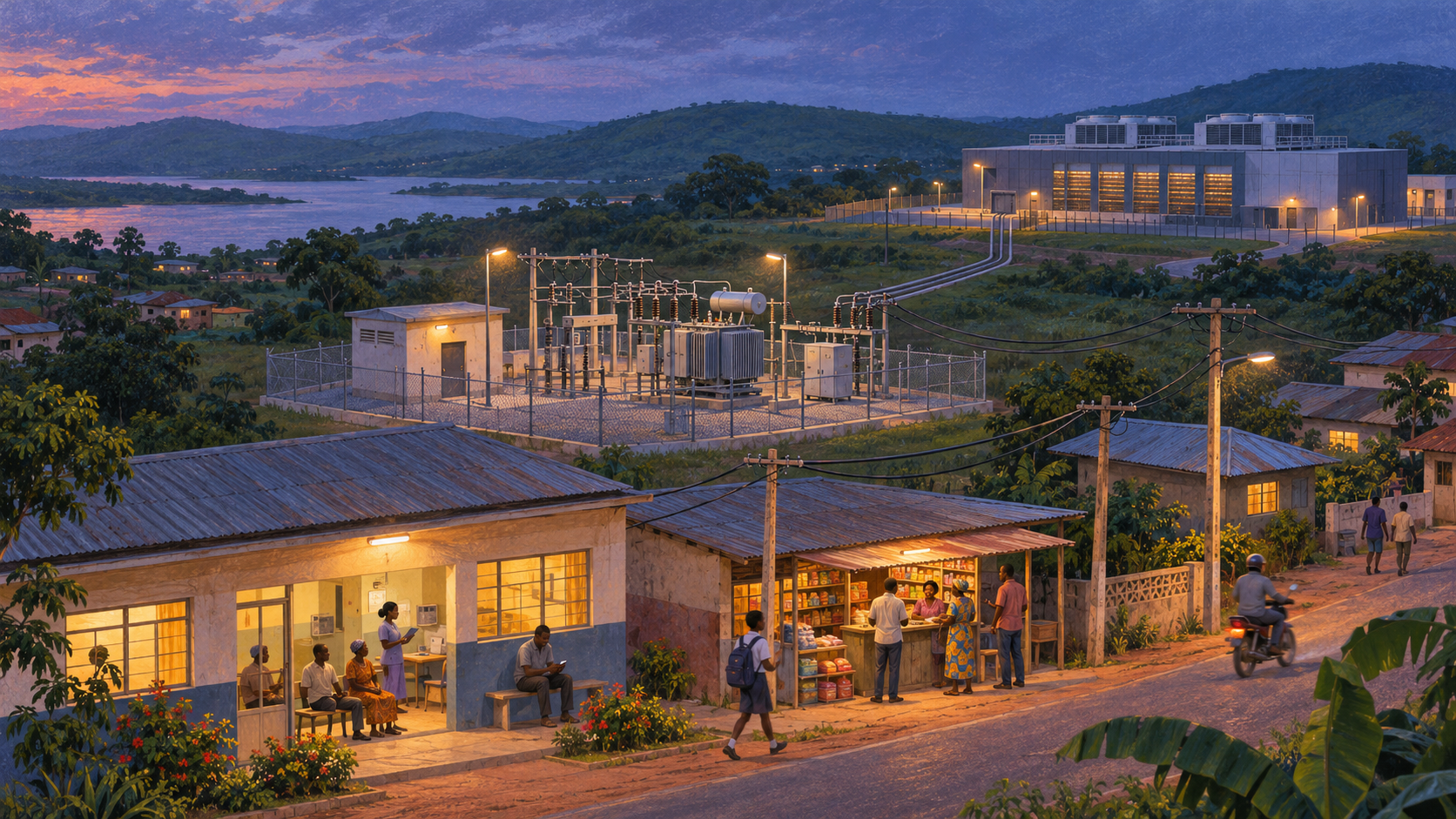
Call it the access dividend: a negotiated share of the capacity, revenue or infrastructure a data centre creates. That share can bring reliable power to households, schools, clinics and small businesses. It could be a substation that also serves a clinic, a line extended to a market town, or a solar-plus-storage system with funding to keep it running after the construction crews leave.
This is the test I propose in the Africa Data Centre–Energy Access Decision Framework (ADCEAD), with Ghana and Kenya as proposed pilots. Before approving a project, assess grid capacity, who pays for upgrades, water and land use, local jobs, and whether affected communities have a say. Then ask: for every megawatt this facility needs, what new capacity, grid upgrade or community connection will it unlock? Write into the agreement who delivers it, who pays and when the public can verify it.
Three cases worth watching
Kenya. Microsoft and G42’s Olkaria proposal envisaged a campus powered by geothermal energy. Its scale raises a question any grid planner should ask: how much of the electricity would be new, and what supply would remain for homes and businesses as the campus expands?
South Africa. In Cape Town, Housing Assembly and Foxglove challenged the approval of a proposed Equinix facility, arguing that too little was disclosed about its electricity and water demand. Water use depends heavily on the cooling design. That is exactly why the developer’s assumptions and projected demand should be available for public scrutiny before approval.
Ghana. The government’s planned AI Compute Centre offers a chance to apply the test early. Where will its electricity come from? Who will pay for a reliable supply and any grid upgrades? What benefit will nearby communities see? A centre that relies on diverting scarce power from existing users shifts the cost of development onto those already underserved.
Treat data centres as development infrastructure
Data centres host payments, public records and systems that schools and hospitals use. If we treat them as development infrastructure, like roads or power stations, the planning table has to include more than the investor and the utility. Ministries, regulators and the people whose water, land and electricity are at stake belong there too.
Much of the debate about AI and jobs asks what happens once the technology is in use. Some of the most consequential choices happen earlier, when someone decides where the infrastructure will go, what it will consume and who will benefit. That is when the access dividend should be negotiated: before approval, while the terms can still change.
Lawrence Agbemabiese is a co-founder of AISESA and a senior research fellow at the Foundation for Renewable Energy and Environment (FREE). This article draws on his abstract “The Access Dividend: Data Centres as Anchor Loads for Energy Access in Africa,” submitted to the 3rd African International Conference (AIC 2027) at the University of Bradford.